
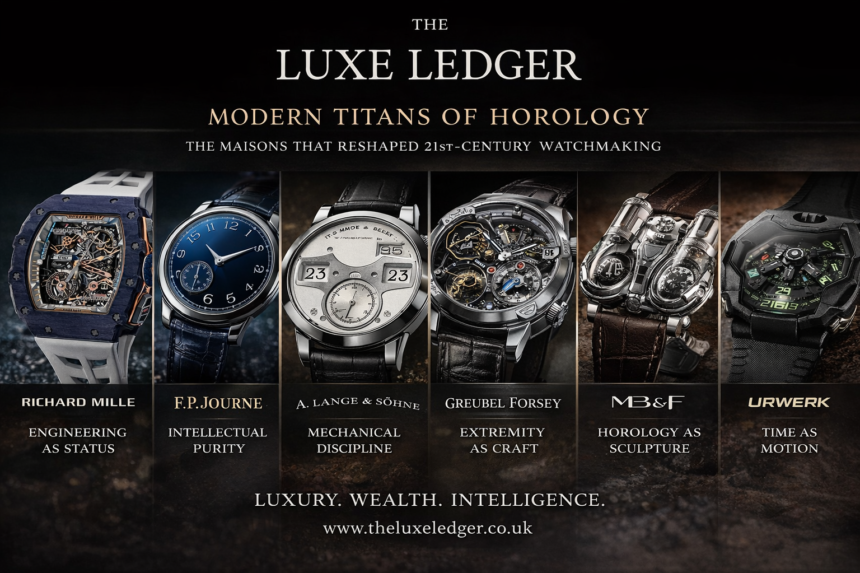
For most of the 20th century, horology was defined by lineage. If a brand had survived world wars, quartz crises, and conglomerate consolidation, it was granted authority by default.
But the 21st century disrupted that comfort.
A new class of collectors emerged — younger, liquid, entrepreneurial, technologically literate. They were not impressed by nostalgia alone. They wanted innovation, materials science, architectural movement design, mechanical audacity.
And so, a new hierarchy formed.
Not the oldest houses.
Not the largest groups.
But the modern titans of horology — brands that didn’t just participate in luxury watchmaking.
They reprogrammed it.
1. Richard Mille: Engineering as Status
Richard Mille did something radical.
He removed fragility from high complication.
Before Richard Mille, a split-seconds chronograph or tourbillon was something you handled delicately. After Richard Mille, athletes wore them mid-competition. Rafael Nadal didn’t remove his tourbillon to serve.
That wasn’t marketing theatre. It was materials science.
Carbon TPT cases
Titanium bridges
Skeletonised calibres built for shock resistance
High-frequency chronographs engineered for sustained use
The RM 41-01 Automatic Split-Seconds Chronograph exemplifies this philosophy: layered architecture, performance logic, unapologetic pricing.
Richard Mille did not simply create expensive watches.
He created a new category: visible mechanical dominance.
And in doing so, he attracted an entirely new kind of capital into horology.
2. F.P. Journe: Intellectual Scarcity
If Richard Mille is velocity, F.P. Journe is restraint.
François-Paul Journe built his maison around a simple but audacious principle:
Invenit et Fecit.
Invented and made.
From the beginning, Journe developed in-house movements. No ébauche reliance. No diluted identity.
The Chronomètre Bleu became a cult object not because of hype, but because collectors recognised intellectual purity.
Journe’s watches are not loud. They are philosophical instruments.
Over time, the market rewarded that integrity:
Ruthenium dial pieces revalued
Early brass movement models now historically significant
Limited production preserving scarcity organically
Journe proved something critical:
In the 21st century, authenticity compounds faster than marketing.
3. A. Lange & Söhne: Mechanical Discipline
After its 1994 revival, A. Lange & Söhne did not attempt Swiss mimicry.
It doubled down on German precision.
The Datograph redefined chronograph finishing standards.
The Zeitwerk reimagined digital time display with constant-force mechanics.
Where Swiss houses leaned into romantic heritage, Lange leaned into discipline:
Three-quarter plates
Hand-engraved balance cocks
Architectural symmetry
The Zeitwerk is especially important in modern horology. It made digital mechanical time not just possible, but desirable.
Lange does not trend.
It accumulates authority.
4. Greubel Forsey: Extremity as Craft
Greubel Forsey operates at the edge of mechanical theory.
Multi-axis tourbillons.
30-degree inclined escapements.
Hand-finishing that borders on obsessive.
Greubel Forsey pieces are not built for mass appeal. They are built to explore what mechanical timekeeping can become when freed from commercial restraint.
Production numbers are minuscule. Prices are stratospheric. Finishing is among the best in the world.
This is horology treated as research and development.
5. MB&F: Horology as Sculpture
MB&F blurred the line between watchmaking and art.
Legacy Machines reinterpret classical horology.
Horological Machines abandon classical structure entirely.
Flying balances suspended over open dials.
Domed sapphire crystals distorting perspective.
Movement-first design philosophy.
MB&F made collectors comfortable with imagination.
In a market often dominated by restraint, MB&F legitimised kinetic expression.
6. Urwerk: Time as Motion
Urwerk removed conventional hands and asked:
What if time were orbital?
Satellite hour systems.
Asymmetric case structures.
Planetary distance readouts.
The UR-100 SpaceTime does not simply display hours and minutes. It visualises Earth’s rotation and orbital travel.
Urwerk reframed time as physics.
And collectors responded.
The Capital Effect: Why These Brands Matter Financially
The modern titan is not just creatively relevant.
It is economically influential.
These maisons:
Introduced new pricing psychology
Shifted attention away from pure heritage plays
Created secondary market resilience outside mainstream conglomerates
The rise of independent watchmaking correlates directly with the rise of tech wealth and entrepreneurial liquidity.
Younger buyers did not want their fathers’ watches.
They wanted mechanical statements aligned with performance, innovation, and structural complexity.
Modern titans met that demand.
The Shift from Heritage to Engineering
The 21st-century luxury buyer is different.
He understands carbon composites.
She understands supply chains.
They understand scarcity mechanics.
A watch must now do more than reference history.
It must:
Demonstrate engineering intent
Justify pricing through innovation
Offer aesthetic differentiation
Maintain controlled production
The brands listed above did not survive by accident.
They engineered relevance.
Are These Investment Watches?
The wrong question is: Will this double next year?
The correct question is:
Does this maison have structural legitimacy?
Richard Mille: Market liquidity + performance prestige
F.P. Journe: Intellectual scarcity + low production
Lange: Institutional respect + technical mastery
Greubel Forsey: Extreme rarity + finishing excellence
MB&F: Artistic identity + strong collector base
Urwerk: Distinct visual language + loyal niche following
These are not meme investments.
They are category-defining brands.
TheLuxeLedger Conclusion
The modern titan of horology is not defined by age.
It is defined by impact.
These maisons:
Changed material usage
Rewrote aesthetic expectations
Attracted new demographics
Forced legacy brands to adapt
The future of high horology will not be written solely by the oldest houses.
It will be written by those who understand that time is no longer just measured.
It is engineered.
It is sculpted.
It is reimagined.
At THE LUXE LEDGER, we document not only watches — but the forces reshaping mechanical wealth.
Luxury. Wealth. Intelligence.
www.theluxeledger.co.uk